Does Squatting Make the Buttocks Bigger?
The question “Does squatting make the buttocks bigger?” is one of the most frequently researched topics among people who want to change the shape of their buttocks. The answer is not simply “yes” or “no.” Squats are an effective exercise that works the glute muscles, but they do not create the same visible change in every person.
To put it more clearly, squats can strengthen the glute muscles and contribute to a certain degree of volume increase; however, the overall shape of the buttocks, their projection, side fullness, and lower-body proportions do not always reach the desired level through squats alone. Genetic structure, fat distribution, and skeletal form are especially decisive here.
The main structure that affects the appearance of the buttocks is not only muscle. Bone structure, pelvic width, the placement of fat tissue, the waist-to-hip ratio, and skin structure also directly affect the final image. For this reason, some people may not see a noticeable roundness in their buttocks despite doing regular squats, while others may notice a change in shape more quickly.
This is also the most important point when answering the question “Does squatting make the buttocks bigger?” Squats contribute to muscle development, but they do not guarantee the same aesthetic result for everyone.
What Do Squats Do in the Body?
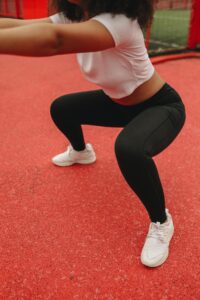
Squats are primarily one of the basic exercises that work the lower-body muscles. They especially help activate the muscles around the buttocks, most notably the gluteus maximus. In addition, they also affect the legs, hips, and core area.
When performed regularly and with proper form, squats can increase muscle tone, improve lower-body strength, and contribute to a tighter appearance in the buttock area. The source explanation also states that squats are effective for strength and mass development in the glute muscles, can improve tone, and can support muscle hypertrophy.
However, there is an important distinction here: strengthening the muscle is not the same thing as the buttocks becoming aesthetically larger. Some people feel more lift and firmness in the buttocks after squats, while others do not achieve the “full and prominent” look they were hoping for.
This is because muscle development happens internally, whereas the silhouette seen from the outside depends not only on the amount of muscle, but also on the fat distribution over that muscle and on anatomical structure. For this reason, a more accurate answer to the question “Does squatting make the buttocks bigger?” would be: “It develops the muscles, but the visible change in appearance may be limited or noticeable depending on the person.”
Why Doesn’t Everyone Get the Same Result?
The shape of the buttocks is largely related to genetics. Some people naturally have rounder and more projected buttocks, while others may have a flatter, squarer structure or side contours that dip inward more. No matter how regularly squats are performed, genetics do not change completely. The source content also states that how the body stores fat and builds muscle is influenced by genetics, and that many people may therefore not reach the silhouette they want through exercise alone.
This is especially important for people with hip dips, a flatter buttock structure, or a desire for a fuller rear profile. Squats can improve the existing muscle tissue, but they do not change fat distribution, fill in the hollows on the sides of the buttocks, or give the buttocks an entirely different skeletal form.
In other words, putting in effort at the gym is valuable, but expectations need to be realistic. The question “Does squatting make the buttocks bigger?” should also be considered together with questions such as “How much bigger?” and “In which body type, how much change can it provide?”
Squats Can Make the Buttocks Bigger, But By How Much?
This question cannot be answered with an exact number of centimeters or a single standard outcome. The glute muscles can develop with regular loading. Especially when there is a proper training program, progressively increased resistance, sufficient protein intake, and a consistent exercise routine, muscle volume can increase. However, that increase is not always the same thing as the exaggeratedly round and prominent buttock appearance often seen on social media.
Some people achieve a more lifted look with squats. In others, only firmness becomes noticeable. In some, the change remains very limited. The reason is that glute growth depends not only on exercise, but also on the starting muscle volume, bone structure, body fat level, and how the program is applied. The source content also emphasizes that squats may not significantly change the shape, projection, or symmetry of the buttocks, especially in people who naturally have a flatter or squarer glute structure.
Are Buttock Shape and Glute Muscle the Same Thing?
No. These two are often confused. Muscle development affects the underlying structure of the buttocks. Buttock shape, however, is a broader issue than that. A person can strengthen their muscles by doing squats, but for the buttocks to look rounder, the position of fat tissue, the structure of the waist indentation, and the fullness of the side hip line may also matter. Especially in side hollows called “hip dips” or in a flat buttock appearance, muscle development alone may not meet expectations.
For this reason, many people who ask “Does squatting make the buttocks bigger?” are actually looking not only for muscle growth, but for a fuller and more shapely appearance. Exercise can support this to a certain extent, but it does not completely reshape the buttock contour. The source article also states that fitness remains limited, especially when it comes to increasing buttock volume or solving certain aesthetic concerns on its own.
Why Do People Wanting More Noticeable Results Look Into Other Methods?
People who want a more obvious change in the appearance of their buttocks may look into different aesthetic methods for the result they cannot achieve through exercise alone. The goal is often a fuller buttock, softer transitions, and a more pronounced silhouette. The source content states that the Brazilian butt lift, or BBL, can provide volume and contouring by using the person’s own fat. The same content also explains that this method can offer a more natural improvement without implants.
What matters here is not to view exercise and aesthetic procedures as enemies of one another. For some people, exercise is enough. For others, exercise is a step that preserves overall firmness but does not provide the desired volume. Therefore, the question “Does squatting make the buttocks bigger?” can sometimes help clarify the level of expectation. For someone who wants a milder change, squats may be enough. For someone who wants a more distinct contour, exercise alone may remain limited.
Why Is Expert Evaluation Important?
When it comes to buttock contouring, the issue cannot be reduced only to exercise advice. The person’s existing structure, buttock volume, fat reserves, body proportions, and expectations should all be evaluated together. Assoc. Prof. Dr. Ulaş Bali is a specialist in plastic and reconstructive surgery; according to the available information, he completed his medical education at Dokuz Eylül University Faculty of Medicine and his specialty training at Celal Bayar University Faculty of Medicine. He has also worked at different hospitals and performed more than 35,000 successful surgeries.
This kind of experience is especially important in fields such as buttock contouring, which require proportion, symmetry, and a natural appearance. Sometimes a person thinks, “If I train more, I can achieve what I couldn’t get from squats,” while sometimes the opposite happens and an unnecessarily large expectation is created for a structure that could actually improve with regular exercise. Expert evaluation helps make that boundary clearer.
The most accurate answer to the question “Does squatting make the buttocks bigger?” is this: squats work and strengthen the glute muscles and can contribute to a certain degree of volume increase; however, they do not change the overall shape, projection, and aesthetic contour of the buttocks to the same extent in everyone. The result varies according to genetic structure, fat distribution, skeletal form, exercise routine, and expectations.
For this reason, squats are an effective and valuable tool for glute development, but they are not a miraculous method that produces the same outcome for everyone. They can be useful for a tighter, stronger, and somewhat fuller appearance. However, for people expecting more distinct volume, a rounder form, or a more dramatic contour, they may not be enough on their own. When evaluating the question “Does squatting make the buttocks bigger?” the healthiest approach is to understand clearly what exercise can change and what it cannot.