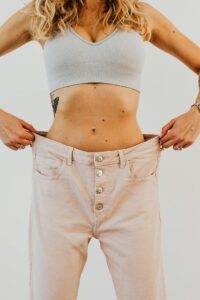
Significant weight loss, whether achieved through diet and exercise, bariatric surgery or one of the newer weight loss medications, changes the body in ways the scales never show. Fat volume reduces, but skin that has been stretched for years does not always follow it back. Many patients reach their target weight and then discover that loose skin on the abdomen, arms, breasts and thighs still hides the result they worked so hard for. Body contouring surgery is the stage that completes that journey. This guide explains which procedures are used, when it is safe to operate, and why the work is usually staged rather than carried out in a single operation.
Why Skin Does Not Shrink Back
Skin owes its elasticity to two components, collagen and elastin. When skin is stretched slowly over several years, those fibres lengthen and a proportion of them are permanently damaged. Age, genetics, sun exposure, smoking and the speed of the weight loss itself all influence how much elasticity is left at the end. Younger skin that was stretched for a short period often retracts well. Skin that carried a large volume for a decade or more usually does not.
This is the reason no cream, wrap, massage protocol or training programme can close a significant skin excess. Exercise builds the muscle underneath, which genuinely improves shape, but it cannot reduce a skin envelope that is now too large for the body inside it. Understanding that difference early saves a great deal of frustration and money.
When Is the Right Time to Operate?
Timing matters more in this group of patients than in almost any other. Operating while the body is still changing means contouring a shape that will not stay, and further weight loss afterwards simply creates new laxity. The usual guidance is:
- Weight stability: a stable weight for at least three to six months, with no active dieting phase planned.
- Distance from bariatric surgery: commonly twelve to eighteen months, once weight loss has clearly plateaued.
- Nutritional recovery: protein, iron, vitamin B12, vitamin D and zinc within healthy ranges, because each of them affects wound healing directly.
- A safe starting point: a body mass index your surgeon considers appropriate for the planned operation and anaesthetic.
Patients who have lost weight using GLP-1 medication need a slightly different conversation. Weight may still be falling month by month, muscle mass is sometimes reduced alongside fat, and the medication has implications for anaesthesia because it slows gastric emptying. These points are discussed with both the prescribing doctor and the surgical team before a date is agreed.
The Areas Most Often Treated
After major weight loss the pattern of excess is fairly predictable. The abdomen is almost always involved, usually with a fold of skin that hangs over the lower abdomen and causes irritation in hot weather. The upper arms lose definition and skin hangs from the back of the arm. The breasts deflate and the nipple descends. The inner thighs rub and chafe when walking. The flanks and back develop rolls that sit above the waistband. Very few patients have all of these in equal measure, and a sensible plan starts with whichever of them affects daily life most.
Arm Lift After Weight Loss
An arm lift, also called brachioplasty, removes excess skin and a modest amount of fat from the upper arm. The incision usually runs along the inner surface of the arm, where it is least visible in everyday positions, and it can extend into the armpit when the looseness continues towards the chest wall. Patients in this group consistently report that the practical gains matter as much as the appearance: sleeves fit properly, the skin no longer swings during movement, and chafing stops. You can read more on our arm lift page.
Abdominoplasty and the Fleur-de-Lis Option
A standard abdominoplasty removes skin between the navel and the pubic area and tightens the abdominal wall, leaving a horizontal scar placed low across the abdomen. After very large weight loss, however, the excess is often horizontal as well as vertical, which means the waist is loose from side to side and a horizontal excision alone cannot narrow it. In those cases a fleur-de-lis abdominoplasty adds a vertical component, so the waist can genuinely be brought in. The trade is a vertical scar in the midline, which most patients in this group accept readily once the alternative is explained honestly. Our tummy tuck page covers both approaches in more detail.
Breast Lift After Weight Loss
Weight loss empties the breast rather than lifting it, so the typical picture is a breast that has lost fullness in the upper pole while the nipple sits low on the chest. A breast lift repositions the remaining tissue and the nipple, and where upper pole fullness is also wanted, an implant or fat transfer is added in the same operation. The choice between a lift alone and a lift with added volume depends on how much breast tissue remains, which is assessed on examination rather than from photographs.
Thigh and Lower Body Contouring
Inner thigh laxity is one of the most troublesome problems after weight loss and also one of the most demanding to treat well, because the scar sits in an area of constant movement with a natural tendency to swell. A thigh lift can deliver a real improvement in comfort and in how clothing fits, but healing takes longer than the arm or abdomen and expectations about scar quality need to be set carefully beforehand. A lower body lift, which addresses the abdomen, hips and outer thighs in one continuous procedure, suits a smaller group of patients whose excess runs right around the body.
Why It Is Rarely One Operation
It is natural to ask for everything to be done at once. Safety sets the limits. Longer operating times increase the risk of blood clots, greater blood loss and wound healing problems, and large simultaneous skin excisions can pull against one another in ways that compromise the final shape. In practice the work is grouped sensibly, often abdomen with arms, or breasts with abdomen, and the remaining areas are planned a few months later once healing is complete. A staged plan almost always produces a better final result than one very long operation.
Preparation, Scars and Recovery
Preparation is more detailed than for a routine cosmetic case. Blood tests, a protein rich diet, stopping smoking well in advance and a clear plan for compression garments all make a measurable difference. Recovery varies by area: most patients are walking on the day of surgery, back to desk based work within two to three weeks, and back to the gym at around six weeks. Scars are the honest compromise in this type of surgery. They are long, they are permanent, and they continue to fade for twelve to eighteen months. Patients who understand that from the first consultation are almost always content with the exchange they have made.
Frequently Asked Questions
How long should I wait after bariatric surgery?
Usually twelve to eighteen months, and only once your weight has been stable for several months and your blood results sit in a healthy range.
Can I have surgery while still using weight loss medication?
Often yes, but the timing is agreed with the doctor prescribing it, since the medication affects both ongoing weight change and anaesthetic planning.
Will the loose skin come back?
Skin that has been removed does not return. Significant weight regain or a further large loss can create new laxity, which is why weight stability beforehand matters so much.
Can liposuction alone correct loose skin?
No. Liposuction removes fat and then relies on the skin retracting. Where elasticity is already lost, the skin itself has to be excised.
How many areas can be treated in one session?
That depends on operating time, your general health and which areas are involved. Two regions in one session is common, with the rest planned as a second stage.