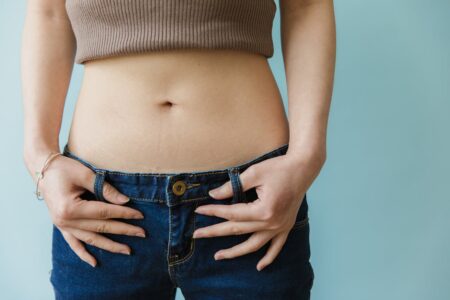
Many women finish pregnancy with a stomach that still looks pregnant months or years later, and they are told to do more core work. They do the planks, the pilates and the deep breathing, the weight comes down, and the shape of the abdomen barely changes. The reason is often not fat and not weak muscle, but a gap between the two halves of the abdominal muscle that exercise cannot close. This condition is called diastasis recti, and recognising it is the difference between years of frustrating effort and a plan that actually works.
What Diastasis Recti Actually Is
The rectus abdominis, the muscle most people call the six pack, runs in two vertical halves down the front of the abdomen. They are joined in the middle by a band of connective tissue called the linea alba. During pregnancy the growing uterus stretches that band sideways and the two muscle halves separate. In most women the gap narrows naturally in the months after delivery. In a significant minority it does not, because the connective tissue has been stretched beyond the point where it can recoil.
The result is a weakened midline. The abdominal contents push forwards against a band that no longer holds them, which is why the abdomen looks rounded even in women who are slim and strong.
How to Recognise It
There is a simple self check. Lie on your back with your knees bent, place your fingertips just above the navel, and lift your head and shoulders slightly as if starting a sit up. If your fingers sink into a soft gap between two firm ridges of muscle, that gap is the separation. Two fingers or more, particularly if the floor of the gap feels soft rather than firm, suggests a meaningful diastasis.
Other signs patients describe include:
- A dome or ridge: the midline bulges outwards when sitting up or coughing.
- An abdomen that looks pregnant: most noticeable at the end of the day or after a meal.
- Lower back discomfort: the abdominal wall is no longer sharing the load properly.
- A weak core: difficulty with lifting or with exercises that were once straightforward.
- Bloating and pressure: a feeling that the abdomen has no support.
Why Exercise Cannot Close the Gap
This is the point that surprises most patients. Exercise works on muscle. Diastasis recti is a problem of connective tissue, and connective tissue that has been permanently stretched does not shorten in response to training. Strengthening the surrounding muscles can improve control, posture and function, and in mild cases that is genuinely enough to improve the appearance. But where the linea alba is widely stretched, no amount of core work will bring the two muscle halves back together.
Worse, certain exercises can make the appearance more obvious. Traditional sit ups, crunches and some planks increase pressure against the weakened midline and push it further forwards. A physiotherapist experienced in postnatal recovery will guide you towards the exercises that help rather than the ones that do not.
When Physiotherapy Is the Right First Step
For a separation under two fingers, or within the first year after delivery, supervised physiotherapy is the sensible starting point. Breath work, deep abdominal control and graded loading can meaningfully improve both function and appearance. Many women need nothing more. Surgery should never be the first conversation after a recent pregnancy, because time alone improves a proportion of cases.
How Diastasis Is Repaired Surgically
When the gap is wide and persistent, the repair is surgical and it is a specific step within an abdominoplasty rather than a side effect of it. Through the same low incision used to remove excess skin, the surgeon brings the two muscle edges together in the midline and secures them with strong internal sutures, rebuilding the abdominal wall from the ribcage down to the pubic bone. This is the part of the operation that flattens the abdomen and narrows the waist, and it is why an abdominoplasty achieves what liposuction cannot. Our abdominoplasty page explains the procedure in full.
Why Liposuction Alone Does Not Help
If the problem is a separated muscle wall, removing fat changes nothing structural. Liposuction can refine the waist and flanks and is frequently combined with a muscle repair, but used alone on a patient with diastasis it tends to produce a thinner abdomen that still protrudes. This is one of the most common reasons patients come for a second opinion after disappointing results elsewhere.
Where It Fits in a Mummy Makeover
Diastasis repair is usually one part of a wider plan. Pregnancy and breastfeeding change the breasts as well as the abdomen, so many patients combine muscle repair and skin removal with a breast lift or augmentation in a single operation. That combination is what the term mummy makeover describes. Whether it is appropriate to do everything at once depends on operating time and your general health, and it is decided case by case.
Timing Around Future Pregnancies
A muscle repair can be undone by a subsequent pregnancy, so the standard advice is to complete your family first. There is no medical rule preventing pregnancy after an abdominoplasty, and women do carry healthy pregnancies afterwards, but the abdominal wall may separate again and a second repair would then be needed. If another pregnancy is planned within the next year or two, physiotherapy and patience are the better choice for now.
Recovery After Muscle Repair
The muscle repair is the reason recovery after an abdominoplasty feels more demanding than skin removal alone. Expect to stand slightly bent for the first few days, to sleep propped up for a week or two, and to avoid lifting anything heavy for six weeks while the internal sutures settle. Walking starts on the day of surgery. Most patients return to desk based work at two to three weeks and to the gym at around six weeks, with core training reintroduced gradually under guidance.
Frequently Asked Questions
Can diastasis recti heal on its own?
Mild separations often improve during the first year after delivery, especially with guided physiotherapy. Wide, long standing gaps rarely close without surgical repair.
How wide does the gap need to be before surgery is considered?
There is no single number. The decision rests on the width, how soft the midline feels, the symptoms you have and how much excess skin is present.
Does the repair also fix loose skin?
The muscle repair rebuilds the wall. Loose skin is removed at the same time as part of the abdominoplasty, which is why the two are normally done together.
Will the separation come back?
A properly performed repair is durable. The main risks to it are a further pregnancy or substantial weight gain.
Can I have the repair without a long scar?
The repair requires access along the midline, which is gained through the standard low abdominal incision. A shorter scar is sometimes possible when skin excess is minimal.